
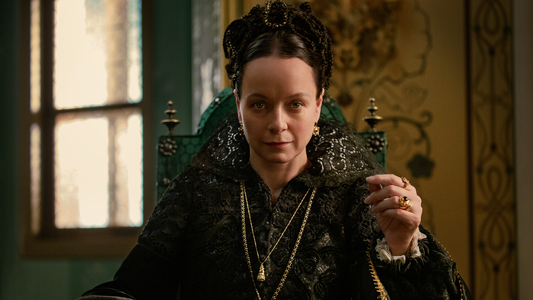
In the treacherous corridors of 16th-century French palaces, where a single misstep could mean exile or death, one woman clawed her way from despised outsider to the most feared and respected figure in the realm. Čūsku karaliene transforms the extraordinary life of Catherine de Medici into a masterclass of political drama, weaving together ambition, survival, and the brutal realities of Renaissance court life into one of television’s most compelling historical offerings.
This Starz production, now captivating audiences on Viasat Epic Drama, presents a Catherine de Medici far removed from the sanitised versions of history textbooks. Here is a woman shaped by abandonment, hardened by betrayal, and driven by an unrelenting will to survive in a world designed to destroy her. The series doesn’t merely chronicle her rise to power—it dissects the very nature of authority, examining how an Italian orphan became the puppet master pulling the strings of an entire kingdom.
A Portrait of Power in Renaissance France
Čūsku karaliene opens not with Catherine’s triumph, but with her vulnerability. Samantha Morton’s nuanced portrayal immediately establishes the complexity that will define the entire series. Here is Catherine as both victim and victor, a woman whose every calculated move stems from the desperate need to never again be powerless. Morton brings a magnetic intensity to the role, capturing both the steely determination that made Catherine legendary and the wounded humanity that drove her to extremes.
The Catherine de Medici series doesn’t shy away from the moral ambiguities that made its protagonist one of history’s most controversial figures. This is not a simple tale of good versus evil, but rather a sophisticated exploration of survival in a world where women had few options and fewer allies. The series asks uncomfortable questions about the price of power and whether the methods Catherine employed were the products of evil or necessity.
What makes this historical drama particularly compelling is its refusal to apologise for Catherine’s actions while simultaneously revealing their origins. Every manipulation, every strategic alliance, every ruthless decision is traced back to its emotional and political roots. The writing understands that Catherine de Medici was not born a serpent—she was forged into one by circumstances that would have destroyed a lesser person.
The Theatre of French Royal Court Drama
The French royal court becomes a character unto itself in this production, a glittering maze of beauty and brutality where appearances deceive and loyalties shift like quicksand. The series excels in its recreation of Renaissance court life, from the sumptuous costumes that signal allegiances and aspirations to the architectural grandeur that both impresses and imprisons its inhabitants.
The attention to historical detail serves the drama rather than overwhelming it. Court ceremonies become stages for political maneuvering, private chambers transform into venues for conspiracy, and even seemingly innocent gatherings carry undercurrents of danger. The series understands that in Catherine’s world, every social interaction was a potential battlefield, every conversation a chess match with life-or-death stakes.
The supporting characters are equally well-crafted, representing the various factions and interests that Catherine must navigate. From ambitious nobles to calculating clergy, each figure in her orbit presents both opportunity and threat. The series particularly excels in showing how Catherine learned to read people’s desires and fears, using that knowledge to forge the alliances that would sustain her through decades of political upheaval.
Dark Humour and Moral Complexity
One of The Serpent Queen’s greatest strengths lies in its tonal sophistication. This is not a grim, relentlessly dark historical drama, nor is it a lightweight costume romp. Instead, it finds the perfect balance between the serious business of political survival and the absurdities inherent in court life. The series employs dark humour not as comic relief, but as a tool to illuminate the contradictions and hypocrisies of aristocratic society.
The writing demonstrates remarkable intelligence in its approach to historical events. Rather than simply dramatising well-known incidents from Catherine’s life, the series explores the psychological and political machinery that made those events inevitable. It shows us not just what Catherine did, but why those actions made sense within the context of her world and experiences.
Perhaps most impressively, the series manages to make Catherine’s story feel utterly contemporary without sacrificing historical authenticity. The power dynamics, the gender politics, the intersection of personal relationships and professional advancement—all resonate with modern audiences while remaining firmly rooted in their Renaissance setting. This is historical drama at its finest, using the past to illuminate timeless truths about human nature and political reality.
The Making of a Queen
The transformation at the heart of Čūsku karaliene is not just political but deeply personal. We witness Catherine’s evolution from a young woman desperate for acceptance to a mature strategist who understands that fear can be more valuable than love. This journey is neither simple nor entirely sympathetic—the series doesn’t ask us to approve of all Catherine’s choices, but it helps us understand how those choices became inevitable.
Samantha Morton’s performance anchors this transformation with remarkable subtlety. She shows us the precise moments when Catherine’s innocence dies, when her compassion becomes calculation, when her vulnerability hardens into armor. Yet even at her most ruthless, Morton ensures we never lose sight of the wounded girl who learned that in a world of predators, becoming the apex predator might be the only path to survival.
The series also excels in its depiction of the constraints and expectations placed upon women in Catherine’s position. It shows how the very qualities that made her an effective ruler—her intelligence, her strategic thinking, her refusal to be manipulated—were seen as threats to the natural order. The historical drama doesn’t simplify these gender dynamics but explores them with the complexity they deserve.
A Legacy Written in Shadows
Čūsku karaliene succeeds because it understands that Catherine de Medici’s story is not just about one remarkable woman, but about the systems of power that shaped her and that she, in turn, learned to manipulate. The series reveals how survival in such a system required not just intelligence and determination, but a willingness to embrace moral ambiguity that would have been unthinkable in her previous life.
The production values supporting this narrative are consistently impressive. The costumes don’t just look historically accurate—they tell stories, revealing character relationships, political alignments, and personal transformations through fabric and design. The sets create an authentic sense of place and period while serving the dramatic needs of each scene. Every element works together to create a world that feels both historically grounded and dramatically compelling.
What sets this French royal court drama apart from other period pieces is its commitment to psychological realism. The series doesn’t present its characters as modern people in period dress, nor does it treat them as incomprehensible figures from a distant past. Instead, it finds the universal human experiences—ambition, love, betrayal, survival—that transcend historical periods while remaining true to the specific pressures and possibilities of Catherine’s world.
The series on Viasat Epic Drama offers viewers a chance to experience one of history’s most fascinating figures through a lens that is both entertaining and enlightening. Čūsku karaliene doesn’t just tell Catherine de Medici’s story—it helps us understand why that story continues to fascinate and disturb us centuries later. In a world where power remains the ultimate prize and the methods of obtaining it haven’t changed as much as we might like to believe, Catherine’s journey from victim to victor offers uncomfortable truths about the nature of authority and the price of survival.
For those drawn to complex characters who defy easy categorisation, to political intrigue that reveals the timeless nature of human ambition, and to historical drama that honours both its period setting and its contemporary relevance, Čūsku karaliene represents television at its most sophisticated. This is storytelling that trusts its audience to grapple with moral complexity while being thoroughly entertained by the spectacle of one woman’s extraordinary rise to power.