
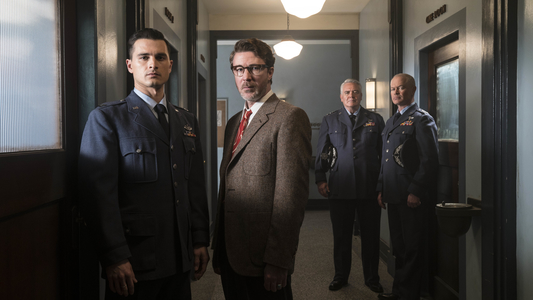
In the shadowy corridors of Cold War America, where every flickering light in the sky could herald either Soviet invasion or something far more inexplicable, the truth became the most dangerous currency of all. Project Blue Book transforms this atmospheric tension into compelling television, weaving together historical fact and speculative fiction to create a UFO drama series that transcends simple science fiction to become something far more sophisticated: a meditation on truth, power, and the lengths governments will go to control both.
Based on the declassified files of the real U.S. Air Force program that investigated UFO sightings from 1952 to 1969, this History Channel production starring Aidan Gillen delivers a historical thriller that feels urgently contemporary. Set against the backdrop of 1950s and 1960s America, the series follows Dr. J. Allen Hynek, a brilliant astrophysicist recruited by the military to debunk UFO reports and calm public hysteria. What begins as routine scientific skepticism gradually evolves into something far more complex as Hynek discovers that the line between explainable phenomena and genuine mystery may be thinner than either science or the government wants to admit.
The Perfect Storm of Paranoia and Wonder
The genius of Project Blue Book lies in its understanding that the most compelling Cold War conspiracy series emerges not from outlandish alien encounters, but from the very human drama of individuals caught between institutional pressure and personal conviction. Aidan Gillen, known for his masterful portrayals of morally complex characters, brings remarkable nuance to Dr. Hynek’s transformation from dutiful debunker to reluctant seeker of truth. His performance anchors the series in emotional reality even as it ventures into increasingly speculative territory.
The historical context proves essential to the show’s power. In an era when Americans lived under the constant threat of nuclear annihilation, when the government conducted secret experiments and maintained classified programs that wouldn’t be revealed for decades, the idea that officials might conceal evidence of extraterrestrial contact felt not just possible but probable. This UFO drama series mines that rich vein of institutional distrust that defined the Cold War period, using the question of alien visitation as a lens through which to examine broader themes of government secrecy, scientific integrity, and the price of truth-telling in a society built on classified information.
Atmosphere and Authenticity
The production design of Project Blue Book creates an immersive period atmosphere that serves the storytelling on multiple levels. The visual language of the series—from the sterile government offices to the vast American landscapes where sightings occur—reinforces the central tension between the mundane bureaucracy of official investigation and the profound implications of what might actually be happening in the skies above. The series creators understand that effective historical thriller television requires meticulous attention to period detail, not just in costumes and sets, but in the rhythms of speech, the social dynamics, and the technological limitations that shaped how people in the 1950s and 1960s processed extraordinary experiences.
The show’s commitment to historical accuracy extends beyond surface details to encompass the actual methodologies and limitations of the original Project Blue Book investigations. Real cases form the backbone of many episodes, with the series dramatizing actual witness testimonies and documented encounters while taking creative license with the personal lives and internal struggles of the investigators. This approach gives the Cold War conspiracy series a foundation of authenticity that elevates it above pure speculation, grounding even its most fantastical elements in documented historical reality.
Character Depth in the Face of the Unknown
What distinguishes Project Blue Book from other entries in the UFO drama series genre is its focus on character development and psychological complexity. Dr. Hynek’s journey from skeptic to believer isn’t presented as a simple conversion narrative, but rather as a gradual erosion of certainty that reflects broader questions about the nature of knowledge and belief. Aidan Gillen’s performance captures the intellectual humility required to acknowledge that scientific materialism might not provide answers to every question, while simultaneously showing the personal cost of such intellectual honesty in a political environment that demands clear, reassuring explanations.
The supporting characters—military officials, witnesses, fellow scientists—represent different approaches to confronting the inexplicable. Some retreat into denial, others embrace conspiracy theories, still others attempt to weaponize mystery for political advantage. These varied responses create a rich ensemble dynamic that explores how different personality types and institutional positions shape individual reactions to phenomena that challenge fundamental assumptions about reality.
The Science of Uncertainty
Perhaps most impressively, this historical thriller manages to maintain scientific credibility even while entertaining speculative possibilities. The series doesn’t ask viewers to abandon critical thinking, but rather to consider how institutional biases and political pressures can distort the scientific process. Dr. Hynek’s investigations follow legitimate scientific methodology—collecting evidence, interviewing witnesses, testing hypotheses—while acknowledging that some questions may not yield to conventional analytical approaches.
This nuanced treatment of the relationship between science and the unexplained gives Project Blue Book intellectual weight that many Cold War conspiracy series lack. Rather than simply pitting believers against skeptics, the show explores how honest investigators navigate the space between what can be proven and what might be possible, between institutional loyalty and intellectual integrity.
Relevance for Contemporary Audiences
The themes that drive Project Blue Book—government secrecy, institutional credibility, the challenge of distinguishing truth from disinformation—resonate powerfully with contemporary audiences navigating their own landscape of competing narratives and classified information. The series arrives at a moment when questions about what governments know and when they reveal it have particular urgency, making this UFO drama series feel remarkably timely despite its historical setting.
The show’s exploration of how institutions shape public understanding of extraordinary events speaks to current debates about expertise, authority, and the democratization of information. Dr. Hynek’s struggle to maintain scientific rigor while acknowledging the limitations of official explanations mirrors contemporary challenges facing experts and institutions seeking to maintain credibility in an era of widespread skepticism about official narratives.
Visual Storytelling and Atmospheric Direction
The directors and cinematographers working on Project Blue Book demonstrate sophisticated understanding of how visual language can reinforce thematic content. The series employs a restrained aesthetic that avoids the flashy special effects often associated with science fiction television, instead using subtle lighting, carefully composed frames, and understated production design to create an atmosphere of mounting unease and possibility.
Night scenes—crucial to a series centered on aerial phenomena—are particularly well-crafted, using darkness and limited visibility to mirror the epistemological uncertainty that drives the narrative. The show understands that what remains unseen or partially glimpsed often proves more compelling than explicit revelation, a principle that serves both the supernatural elements and the political thriller aspects of the storytelling.
The Power of Declassified Truth
One of the most compelling aspects of this Cold War conspiracy series is its foundation in declassified government documents. The real Project Blue Book files, released decades after the program’s conclusion, provide a treasure trove of witness testimonies, official reports, and bureaucratic correspondence that reveal both the systematic nature of the government’s UFO investigations and the often inadequate explanations offered for genuinely puzzling incidents.
This documentary foundation gives the series a weight and credibility that purely fictional approaches to similar material often lack. Viewers watching Project Blue Book on Viasat Epic Drama aren’t just consuming entertainment; they’re engaging with dramatized versions of actual historical events, real witness accounts, and documented government responses to phenomena that, in many cases, remain unexplained even today.
The series creators demonstrate admirable restraint in their use of this source material, avoiding the temptation to sensationalize or over-interpret the historical record while still crafting dramatically satisfying television. This balance between historical responsibility and narrative effectiveness marks Project Blue Book as a particularly sophisticated entry in the historical thriller genre.
Aidan Gillen’s portrayal of Dr. Hynek serves as the emotional and intellectual center around which these larger themes revolve. His performance captures not just the character’s professional evolution but his personal cost of pursuing truth in an institutional environment that often prioritizes political expedience over scientific accuracy. The actor brings the same intensity and complexity he’s demonstrated in other prestige television roles while adapting his approach to serve the specific demands of this historical character and setting.
For viewers who appreciate television drama that challenges assumptions while delivering compelling entertainment, Project Blue Book offers a unique blend of historical authenticity, speculative possibility, and character-driven storytelling. The series proves that the most effective conspiracy thrillers emerge not from paranoid fantasy but from careful examination of documented historical realities that prove stranger and more complex than fiction.
Viasat Epic Drama provides the perfect platform for experiencing this meticulously crafted UFO drama series, allowing audiences to fully appreciate the visual sophistication and narrative complexity that make Project Blue Book such a distinctive addition to the Cold War conspiracy series genre. Whether you’re drawn by the historical intrigue, the scientific speculation, or simply the pleasure of watching Aidan Gillen navigate another morally complex character, Project Blue Book rewards careful viewing with rich storytelling that lingers long after the credits roll.