
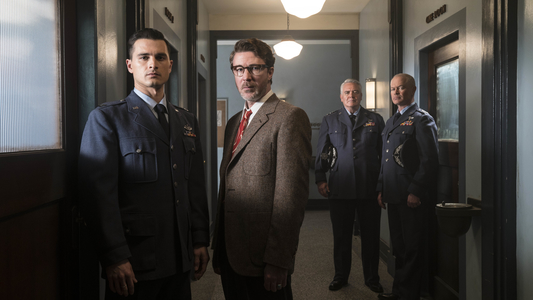
In the shadowy corridors of 1950s America, where Cold War anxiety permeated every aspect of daily life, the skies themselves became a battleground of mystery and mistrust. History Channel’s “Project Blue Book” plunges viewers into this atmosphere of mounting tension, where unidentified objects in the sky could mean Soviet infiltration, mass hysteria, or something far more extraordinary. This UFO drama series transforms declassified government files into compelling television, weaving together scientific skepticism, government conspiracy, and the tantalizing possibility that we are not alone.
Based on the real-life United States Air Force investigations that ran from 1952 to 1969, Project Blue Book follows the unlikely partnership between Dr. J. Allen Hynek, played with characteristic intensity by Aidan Gillen, and Captain Michael Quinn, a military officer tasked with debunking UFO sightings. Gillen, known for his memorable turns in “Game of Thrones” and “The Wire,” brings a measured gravitas to the role of the astronomer-turned-investigator, a man whose scientific worldview becomes increasingly challenged by encounters that defy conventional explanation.
The Science of the Unexplained
What elevates this Cold War conspiracy series beyond typical alien invasion fare is its grounding in historical authenticity and character psychology. Dr. Hynek begins as a firm skeptic, armed with scientific methodology and a mandate to provide rational explanations for seemingly irrational phenomena. Yet as each case unfolds, viewers witness his gradual transformation from debunker to believer, a journey that mirrors the era’s broader questions about truth, authority, and the limits of human knowledge.
The series excels in capturing the period’s particular brand of paranoia, where the fear of communist infiltration intersected with emerging questions about government transparency. Each episode functions as both procedural investigation and historical thriller, examining how ordinary citizens reporting extraordinary experiences were often caught between military secrecy and public ridicule. The production design meticulously recreates the buttoned-up world of 1950s bureaucracy, from sterile government offices to small-town diners where witnesses nervously recount their encounters.
Atmosphere and Authenticity
Project Blue Book succeeds because it treats its subject matter with genuine respect, avoiding both cynical dismissal and credulous acceptance. The writing maintains thriller pacing while exploring deeper themes about scientific integrity, government accountability, and the human need to understand our place in the universe. The series draws from actual declassified files, lending each investigation an unsettling plausibility that purely fictional accounts often lack.
The visual storytelling creates an atmosphere of perpetual unease, where even mundane scenes carry undertones of surveillance and secrecy. This historical thriller understands that the most effective mysteries emerge not from spectacular revelations but from the accumulation of small, inexplicable details that gradually erode certainty. The Cold War setting provides the perfect backdrop for this erosion, a time when Americans were already questioning what their government might be hiding from them.
For viewers who appreciate the moral complexity of “The Americans” or the period authenticity of “Mad Men,” Project Blue Book offers a unique blend of historical drama and speculative fiction. Its exploration of truth, belief, and institutional power resonates particularly strongly in our current era of information uncertainty.
Experience this compelling blend of mystery and history when Project Blue Book premieres on Viasat Epic Drama, where the truth remains tantalizingly out there.